中文
中文


- Small Spray Dryer Machine Manufacturer For milk powder

- Product Detail
- Company Profile
- Pharmaceuticals (API, excipients)
- Food & beverage (milk powder, flavors)
- Chemicals (catalysts, materials)
- Universities & R&D labs
Overview of small spray dryer machine
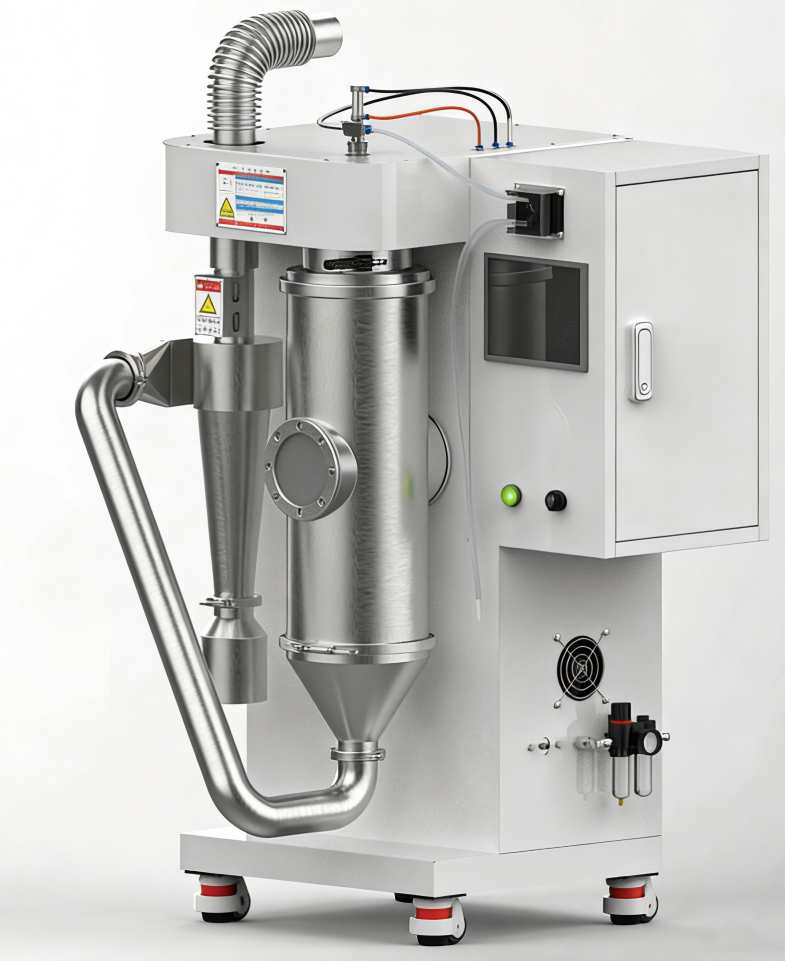
The SDG-2L Laboratory Spray Dryer represents the culmination of our company's meticulous development efforts in this field. The unit features a compact, self-contained design that requires no external auxiliary facilities to operate. It is controlled via a large, full-color LCD touchscreen interface; the outer casing is high-grade SS304, and the drying chamber and cyclone separator are made of quartz glass. The system utilizes fully sealed clamp connections and is equipped with a dedicated intelligent control system, as well as a three-stage adjustable heating system. This configuration provides a broader range of thermal power coverage, enabling the unit to effectively handle the spray drying requirements of the vast majority of materials.
Working principle:
Spray dryers are primarily used to transform solutions, emulsions, suspensions, and paste-like materials into dry powders via spray drying. They offer numerous advantages, including rapid drying speeds, high efficiency, and a streamlined processing workflow. For heat-sensitive materials, the process effectively preserves their original color, aroma, and flavor; furthermore, the resulting dry powders exhibit excellent solubility and high purity. This series of spray dryers is widely applicable across various sectors, including chemical engineering, petrochemicals, light industry, food processing, pharmaceuticals, building materials, ceramics, and forest chemical industries.
Heated air enters the drying chamber after passing through a heater. Simultaneously, the liquid feedstock is atomized by an atomizer into micron-sized droplets. Upon contact with the hot air, these droplets rapidly vaporize and dry, transforming into a powder or granular product. The dried powder or granules are then carried by the airflow into a cyclone separator for separation, where they settle into a collection bottle; finally, the exhaust gas is discharged.
Application:
The laboratory spray dryer is designed for use in universities, research institutes, and the laboratories of food, pharmaceutical, and chemical enterprises for the production of small-scale particulate powders. It offers broad applicability across a wide range of liquid formulations—including emulsions and suspensions—and is particularly well-suited for drying heat-sensitive substances, such as biological products, biopesticides, and enzyme preparations. Because the sprayed material is exposed to high temperatures only during the brief, instantaneous moment it exists in an atomized state, these active substances retain their original biological activity and integrity after drying.
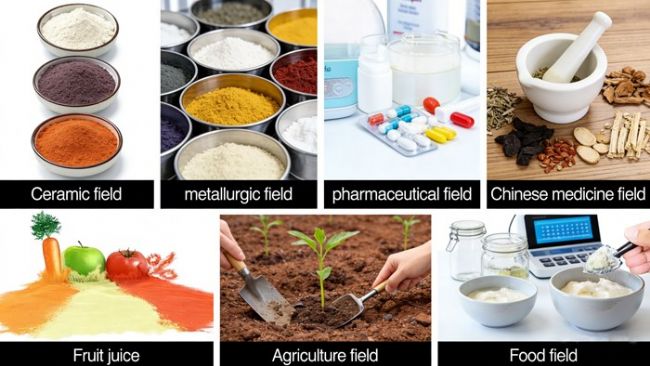
Specifically, this equipment is utilized in the following fields: beverages, flavorings, and pigments; milk and egg products; plant and vegetable extracts; pharmaceutical synthesis; heat-sensitive materials; plastics, polymers, and resins; fragrances; blood products; ceramics and superconductors; biochemical products; dyes; soaps and detergents; food additives; oxides; bone meal; dental powders; and many others.
Advantages:
1. It is made of high-quality 304 stainless steel, the unit features a dual-stage heating system that rapidly reaches the set temperature within one minute, enabling faster experiment initiation. It demonstrates excellent long-term heating stability, compared to other spray dryers currently on the market, yields a product powder with a significantly lower moisture content.
2. The atomizing nozzle utilizes a concentric design with adjustable particle size, ensuring continuous and uniform atomization throughout the experiment while preventing material from adhering to the chamber walls.
3. Equipped with a built-in bilingual (Chinese/English) interface, the system offers an intuitive human-machine interaction experience that eliminates the need for frequent switching during experiments; furthermore, experimental parameters can be saved for convenient recall and reuse.
4. All pipeline connection points are sealed using silicone gaskets secured by full-circumference clamps, ensuring a completely leak-free operation.
5.Prior to shipment, every unit undergoes a rigorous series of quality control tests to guarantee long-term operational stability and reliability for the customer.
Specifications
|
Model |
SD-G-2L |
|
Applicable Materials |
Solution, partial suspension |
|
Water evaporation capacity |
MAX.2000ml/h |
|
Temperature Setting Range |
RT-300℃(Inlet Temperature) |
|
Temperature Accuracy |
±0.1℃ |
|
Drying Air Volume |
Variable Frequency Control: MAX 105 m³/h |
|
Spray Air Pressure |
Adjustable: MAX 0.7 MPa |
|
Atomizing Nozzle |
SS316 Stainless Steel; Concentric Atomization; Exclusive |
|
Temperature Control |
PID Digital Real-Time Temperature Control |
|
Touchscreen |
Display and Adjustment of Parameters: Temperature, Airflow Speed, Feed Rate, Cleaning Cycle, Historical Data, etc. |
|
Control System |
Embedded Intelligent Control System (Dedicated to Spray Drying) |
|
Temperature Sensor |
PT100*2 |
|
Heater |
MAX 2.2 / 4.4 / 8.8 kW: Three-Stage Adjustable Maximum Power; Dual Heating Elements for Enhanced Efficiency |
|
Air Inlet Duct |
Fully Sealed Design; Double-Layered Polygonal Ducting; Double-Layer Thermal Insulation; Quick-Open Mechanism for Easy Maintenance |
|
Material Feed |
Peristaltic Pump |
|
Air Compressor |
0.55kW 8L |
|
Fan |
0.75 kW; Aluminum Alloy Construction; Pressurized; Variable Frequency Speed Control |
|
Relay |
Omron |
|
Leakage Protection |
Chint |
|
Security Features
|
Over-temperature protection, over-current protection |
|
Dimensions |
L*W*H(mm) 800×800×1310 |
|
Weight |
120kg |
|
Power Supply |
Single phase 220V,50/60Hz, customized as request |
|
Accessories |
Extended High-Borosilicate Glass Drying Chamber ×1, High-Borosilicate Glass Cyclone Separator ×1, High-Borosilicate Glass Sample Collection Bottle ×1, High-Borosilicate Glass Waste Collection Bottle ×1, Silicone Feed Tubing ×1, Full-Enclosure Clamps ×4, Sealing Gaskets ×4, Elbow Connector ×1, Exhaust Pipe ×1, Sealing Ring ×1 |
FAQS
Q1: What is a lab spray dryer?
A lab spray dryer is a small-scale drying system used to convert liquid solutions or suspensions into dry powder through rapid hot air drying.
Q2: How does a lab spray dryer work?
The liquid is atomized into fine droplets, which are quickly dried by hot air inside a chamber, forming powder collected by a cyclone separator.
Q3: What is it used for?
Widely used in:
Q4: What materials can be processed?
Solutions
Emulsions
Suspensions
Typical products:
Herbal extracts
Protein powders
Ceramic materials
Q5: What parameters are important?
Inlet temperature
Feed rate
Airflow
Atomization type
Q7: Do you support customization?
Yes, including:
Glass or stainless steel system
Closed-loop (for organic solvents)
Inert gas protection
Q8: How to choose the right model?
Based on:
Sample type
Solvent (water or organic)
Output requirement
Application (R&D or pilot scale)
Q9: How to get a quotation?
Please provide:
Material details
Solvent type
Expected capacity
Special requirements
Please share your inquiry,We will recommend the most suitable model for your application.
-
KAIMINA TECHNOLOGY Integrated of manufacturing R&D and sales of equipments on synthesis reaction, mixing and separation, evaporation and fermentation etc. Our products are mainly used in chemical industry, pharmaceutical, hydrometallurgy, food, new materials, new energy, environmental protection and other fields.
The company adheres to the principle of "customer first, service first, product first", with professional processing equipment, scientific and reasonable production technology, excellence in manufacturing requirements, strict quality control system and perfect after-sales service, and the purpose of win-win cooperation. Provide professional and high-quality products and services to every customer.
Our company currently has two specialized production and processing bases, and has carried out in-depth cooperation with Tsinghua University, Zhejiang University, Central South University, Sichuan University, Chongqing University, Tianjin University, Chinese Academy of Sciences and many other universities, continuously improving our capabilities of R&D and equipment application .
| Request Information |
| Other Products |
| Related Products |